Digital Literacy Model
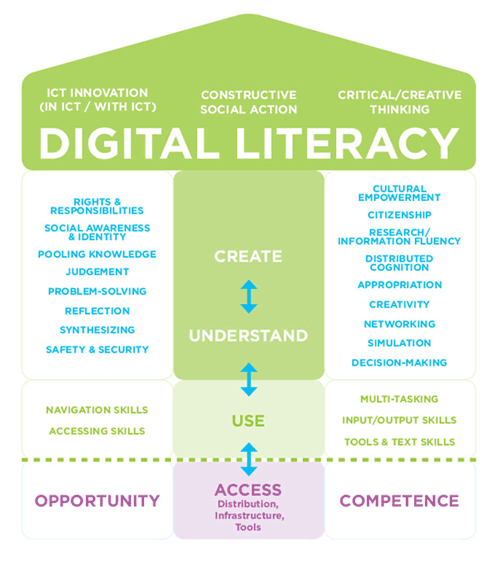
This model[2] illustrates the many interrelated elements that fall under the digital literacy umbrella. These range from basic access, awareness and training to inform citizens and build consumer and user confidence to highly sophisticated, and more complex creative and critical literacies and outcomes.[3] There is a logical progression from the more fundamental skills towards the higher, more transformative levels, but doing so is not necessarily a sequential process: much depends on the needs of individual users.
Use, Understand, Create
Traditional definitions of literacy have focused on skills relating to numeracy, listening, speaking, reading, writing and critical thinking, with the end goal being developing active thinkers and learners who are able to engage in society in effective and meaningful ways.[4] These skills are needed for full participation in digital society as well, but they are only part of a larger set of skills and competencies that are required.Competencies for digital literacy can be classified according to three main principles: Use, Understand and Create.
Use represents the technical fluency that’s needed to engage with computers and the Internet. Skills and competencies that fall under “use” range from basic technical know-how – using computer programs such as word processors, web browsers, email, and other communication tools – to the more sophisticated abilities for accessing and using knowledge resources, such as search engines and online databases, and emerging technologies such as cloud computing.
Understand is that critical piece – it’s the set of skills that help us comprehend, contextualize, and critically evaluate digital media, so that we can make informed decisions about what we do and encounter online. These are the essential skills that we need to start teaching our kids as soon as they go online.
Understand includes recognizing how networked technology affects our behaviour and our perceptions, beliefs and feelings about the world around us.
Understand also prepares us for a knowledge economy as we develop – individually and collectively – information management skills for finding, evaluating and effectively using information to communicate, collaborate and solve problems.
Create is the ability to produce content and effectively communicate through a variety of digital media tools. Creation with digital media is more than knowing how to use a word processor or write an email: it includes being able to adapt what we produce for various contexts and audiences; to create and communicate using rich media such as images, video and sound; and to effectively and responsibly engage with Web 2.0 user-generated content such as blogs and discussion forums, video and photo sharing, social gaming and other forms of social media.
The ability to create using digital media ensures that Canadians are active contributors to digital society. Creation – whether through blogs, tweets, wikis or any of the hundreds of avenues for expression and sharing online – is at the heart of citizenship and innovation.
Given how quickly and frequently our media world is evolving, developing and maintaining one’s digital literacy is a lifelong process. The specific skills that are needed will vary from person to person depending on their needs and circumstances – which can range from basic awareness and training to more sophisticated and complex applications.
The Multi-Literacies of the Digital Age
Digital literacy is more than technological know-how: it includes a wide variety of ethical, social, and reflective practices that are embedded in work, learning, leisure, and daily life.The term “multi-literacies” is often used to describe the various aptitudes and abilities that are needed for us to use, understand and create digital media. Given this, it’s helpful to think of “digital literacy” not as a concrete set of skills, but as a framework that draws from and expands on numerous literacies and competencies.
Under the “digital literacy umbrella” are a wide range of interrelated skills that traditionally fall under media literacy, technology literacy, information literacy, visual literacy, communication literacy and social literacies.[5]
Media literacy:
With its expanded notion of ‘text’ that includes images, audio and digital media, media literacy is closely associated with digital literacy. Media literacy reflects our ability to access, analyze, evaluate and produce media through understanding and appreciation of:- the art, meaning and messaging of various forms of media texts
- the impact and influence of mass media and popular culture
- how media texts are constructed and why they are produced
- how media can be used to communicate our own ideas effectively
Technology literacy:
Proficiency with technology is most often associated with digital literacy. This ranges from basic computer skills to more complex tasks like editing a digital film or writing computer code.We have to be careful, though, not to confuse proficiency with knowledge and understanding: a teched-up teen with superb technology skills may still trust much of the information he/she finds online, copy straight off the Web for school projects, and not give a thought to the privacy implications of his/her online activities. Digital literacy involves both skills and a set of good online habits that include reflection, critical awareness and responsibility.
Information literacy:
This is another important aspect of being digitally literate that includes the ability to assess what information is needed, to know how to find it online and how to critically evaluate and apply it. Originally developed for library use, this literacy translates well into the digital domain where, in a sea of unfiltered online information, knowing how to think critically about sources and content is essential.Visual literacy:
At its most basic, visual literacy reflects our ability to understand and produce visual messages, whether through objects, actions or symbols. Visual literacy is essential to both learning and communication in modern society.Communication literacy:
These competencies form the foundation for thinking, organizing and connecting with others in a networked society. In particular, today’s youth need not only to understand how to integrate knowledge from multiple sources such as music, video, online databases, and other media[6]; they also need to know how to use multiple sources to disseminate and share knowledge.Social literacy:
Social competencies are also needed for full participation in digital society, which media scholar Henry Jenkins describes as a “participatory culture” that is developed through collaboration and networking.In such a world, youth need skills for working within social networks, for pooling knowledge within a collective intelligence, for negotiating across cultural differences that shape the governing assumptions in different communities and for reconciling conflicting bits of data to form a coherent picture of the world around them.[7]
Jenkins identifies a series of “new literacies” that are built upon and reinforce these social skills. These include:
Play – the capacity to experiment with one’s surroundings as a form of problem-solving
Performance – the ability to adopt alternative identities for the purpose of improvisation and discovery
Simulation – the ability to interpret and construct dynamic models of real-world processes
Appropriation – the ability to meaningfully sample and remix media content
Multitasking – the ability to scan one’s environment and shift focus as needed to salient details
Distributed Cognition – the ability to interact meaningfully with tools that expand mental capacities
Collective Intelligence – the ability to pool knowledge and compare notes with others toward a common goal
Judgment – the ability to evaluate the reliability and credibility of different information sources
Transmedia Navigation – the ability to follow the flow of stories and information across multiple platforms (understanding a storyline that’s told both on a TV show and a website, for instance, or following a news story through various different outlets)
Networking – the ability to search for, synthesize, and disseminate information
Negotiation – the ability to travel across diverse communities, discerning and respecting multiple perspectives, and grasping and following alternative norms.[8]
Globally, the International Society for Technology in Education (ISTE) frames its benchmarks for digital literacy around six standards: creativity and innovation; communication and collaboration; research and information fluency; critical thinking, problem solving, and decision making; digital citizenship; and technology operations and concepts.[9]
Where Does “Digital Citizenship” Fit In?
Digital Citizenship is “character education” in a networked world. As one teacher puts it:One of the big mission statements and themes of our school is building character today for communities of tomorrow, so we are always tying things back into good character and how we want to be perceived by others; how we want to treat others; and how we want others to treat us … technology provides one more way to teach it, one more way to make it relevant to students.[10]
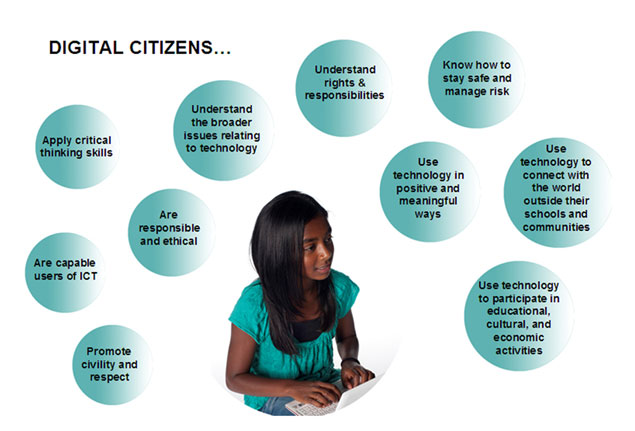
Being a critically engaged user and consumer of media is an essential part of active citizenship in the 21st century: we use media to inform ourselves, to help shape our opinions, to interact with our communities and to make our voices heard.
Models for digital citizenship are generally framed around elements such as rights and responsibilities, participation or civic engagement, norms of behaviour or etiquette and a sense of belonging and membership.[11][12]
Digital citizenship is closely aligned to civics in a traditional sense, where understanding digital media and being able to use it is becoming a vital part of active citizenship. As media messages dominate our political debates and tools such as Facebook and Twitter are used for activism and organizing political movements around the world, it’s increasingly important for young people to be able to view media critically and be prepared to be engaged digital citizens who contribute to their communities in a positive way. To do so, they need the full range of skills we associate with media and digital literacy to be able to know and exercise the rights they hold as consumers, as members of online communities, as citizens of a state and as human beings.
Fostering Digital Literacy in the Classroom
Many teachers are using technology in their classrooms to support different learning styles and to engage students: what’s missing are guidelines to help them do this in ways that promote innovative thinking and collaborative work, promote ethical practices and strengthen their own professional development.Teachers, interviewed by MediaSmarts, identified several key factors that limit the ability of educators to help students build digital literacy skills. They also offered some solutions to these problems, including the need to:
- provide students with authentic learning opportunities that are enhanced through technological tools;
- position teachers as facilitators and co-learners, instead of “drill and kill” experts;
- focus teacher training on how to use technology to enhance learning and meet curricular outcomes; and
- create reasonable policies and less restrictive filters in schools so that teachers can better help students develop and exercise good judgement.[13]
This is where our education system can benefit from models in the youth engagement sector, where young people are acknowledged as decision-makers, partners and agents of social change, and adults assume the role of trusted guides and lifelong learners alongside youth.[14]
One of the supporting principles of Manitoba’s Continuum Model for Literacy with ICT is the gradual release of responsibility from teacher to student.[15] According to this principle, teachers act as facilitators and guides who provide scaffolding to help students develop higher-level critical and creative thinking and deeper understanding relating to ICT as they gradually become more autonomous users of networked technology.[16]
This principle fits well into effective programs for digital literacy and digital citizenship that:
Are holistic, building links between school, home and the community and taking into account both online and offline opportunities for engagement and empowerment
- Are evidence-based
- Are proactive, as opposed to reactive
- Position digital technology as a right and a responsibility
- Reinforce positive and pro-social uses of technology
- Provide a wide range of tools and resources
- Focus not just on safety, but the whole range of digital literacy skills and competencies
- Are built upon traditional aspects of character and moral education as well as a broader interpretation of civics education
- Are child-centred and youth-led – building on the reality of young people’s lives and providing real and authentic experiences
- Foster a gradual release of responsibility towards independent practice by youth – working with youth in building resilience, finding solutions and promoting positive engagement with technology
- Position adults as supportive mentors and facilitators
INFORMATION FLUENCY
Information fluency is a state of competency in any subject (or set of subjects) which we believe to be a good goal for students to achieve in a class, and for which a class may be designed. The terms for this model have been chosen carefully. It is information, not digital. Many parts of the information fluency model are analog, or comprised of characteristics for which the digital/analog terminology isn’t germane. It is fluency, not literacy. Digital literacy is the keyboarding and filing skills set of the information age, a sometimes vexing, but essentially solved, problem. Anyone who has learned– or attempted to learn– a foreign language should intuitively understand the distinction between literacy and fluency… with the former, one can get around; with the latter one can express themselves creatively.
Information Fluency is a model that builds on the skills of traditional digital literacy, integrating technology with domain (discipline) specific knowledge, critical thinking, presentation, participation and communication skills. Being fluent connotes understanding.
The Information Fluency Triad

Domain Knowledge
Domain knowledge is the “stuff” we teach. However, this is not limited to discipline specific information and facts, but also:- knowledge of information resources such as publications, databases, search tools, web resources, etc.
- understanding of the community of learners, enthusiasts and professionals in that area
- tools needed to browse, explore and discover needed information
- methods for storing, managing, retrieving and sharing
Critical Thinking
Critical thinking is something every educator thinks about and probably has a pet definition for. The intent with the Information Fluency model is that critical thinking is represented by the ability to:- analyze and evaluate information
- conceptualize and integrate new learning
- analogize and create parallels
- formulate and answer questions use knowledge for problem-solving
- think tangentially and orthogonally
- paying attention to oneself and
- modifying one’s own behavior to improve understanding and ability.
Presentation and Participation
Presentation and participation represent a trend toward increased emphasis on learning community, both inside and outside the classroom.Presentation and participation include traditional activities, such as in-class presentations and readings, but also new activities and forums possible due to the affordances of technology, including participation in discussion boards, collaborative activities using tools like wikis and VoiceThreads, blogging and participation in social networks.
Important characteristics of presentation and participation include:
- the ability to create effective presentations designed for the specific audience using the appropriate media
- comprehension of context, tone and basic rhetoric
- knowledge to re-purpose information successfully for use in new contexts
- a developed capacity for handling, evaluating, and integrating commentary and criticism from others
- an understanding of the processes and value of self-reflection
How Can I Use Information Fluency in My Class?
The Information Fluency Triad is a helpful lens for assessing student understanding. Students who do not exhibit an ability to work the subject of your course in and between each of the three IFT spheres may be portraying their incomplete understanding of your subject. Depending on where they fail to meet standards, say they seem to have rigorously studied the assigned reading but their presentations are uninspired, the IFT can help you to diagnose where the process has broken down in the students’ process, and how you may go about helping them.“Mere” Information Proficiency (A Two-Legged Stool)
The three areas of the triad work together to create Information Fluency. As you can see, any combination of just two of them reaches a different, possibly incomplete result– the proverbial two-legged stool:
Domain Knowledge + Critical Thinking: Isolated, Untested Insight
One can have great mastery of the resources and information associated with a discipline– what is often referred to as “the content”– and strong critical thinking skills (however one defines them), but without the ability to participate in the communities in which that discipline’s knowledge and wisdom reside and to present clearly, powerfully and persuasively, the value of one’s individual insight is greatly limited. In an increasingly technologically mediated world, opportunities and demands to participate in communities of learning and practice– and to present what one knows (or wants to know) to others– are likewise increasing. Further, our understanding and position is strengthened– together they become resilient– through the processes of presentation and participation, allowing us to deepen our understanding, account for arguments and alternatives, and learn to revise and rethink.
Critical Thinking + Presentation/Participation: Rhetoric & Sophistry
Without an adequate and dynamic pool of disciplinary knowledge to draw from, interrogate, and build on, one’s critical thinking and presentation skills are just that– presentation skills. One might be highly polished, skilled at making a point or sending a message, and temporarily convincing, but that message won’t stand up to scrutiny. While there is much to be said for the art of rhetoric, sophistry is ultimately an incomplete and insufficient to be fully-fledged members of a community of learning or practice.
Presentation/Participation + Domain Knowledge: Reporting & Reportage
Critical thinking can be thought of as the set of skills that allows us to do more than merely report (in the literal sense, reporting should be an art that– no matter where one stands on the idea of objectivity– demands as much critical thinking as any other form of creative writing) information and events. The ability to interpret, question, reflect, revise, connect, synthesize, and generate new information and knowledge are only possible if we combine our existing knowledge with the activities that characterize critical thinking.How Can My Students Use Information Fluency?
A Cycle of Resources, Actions, Activities
Information Fluency isn’t just a theoretical concept, but one which has practical application in any course. It is a lens by which you can evaluate individual outcomes, assessment and activities in your course and the course as a whole. In this diagram we have mapped some common actions and activities to the Information Fluency triad.

Solution Fluency
Develop problem-solving superpowers
Information Fluency
Learn Sherlock-style data skills
Creativity Fluency
Unleash your inner Picasso
Media Fluency
Be the next Spielberg


No comments:
Post a Comment